
Short answer
To get real estate leads from local communities, define the area and services you cover, monitor explicit requests for an agent, review the person’s stated need and timing, then answer the question transparently. Track conversations and agreed next steps rather than counting every property mention as a lead.
Let BuyerSpotter watch your groups and searches for you. 7-day trial, no card needed.
Add to ChromeKey takeaways
- Keep buyer, seller and rental requests in separate review categories.
- Choose sources by relevant conversations, not member counts alone.
- Use only the needs people state; do not infer personal circumstances.
- Offer one useful next step and record what the person actually agrees to.
Define which real estate conversations you can help with
Start with the services you actually provide and the areas you cover. Buyer representation, selling a home, rental searches and property management involve different questions and next steps. A broad alert for “house” mixes them together with renovation advice, listings and general news. Write a separate brief for each service instead.
An example brief might be: “People asking for an agent to help sell a home in the towns I serve.” It names a service and an explicit request without assuming anything about the author’s finances or personal situation. A person discussing a neighborhood is not automatically looking for an agent. Keep general local research separate from your queue of people asking for professional help.
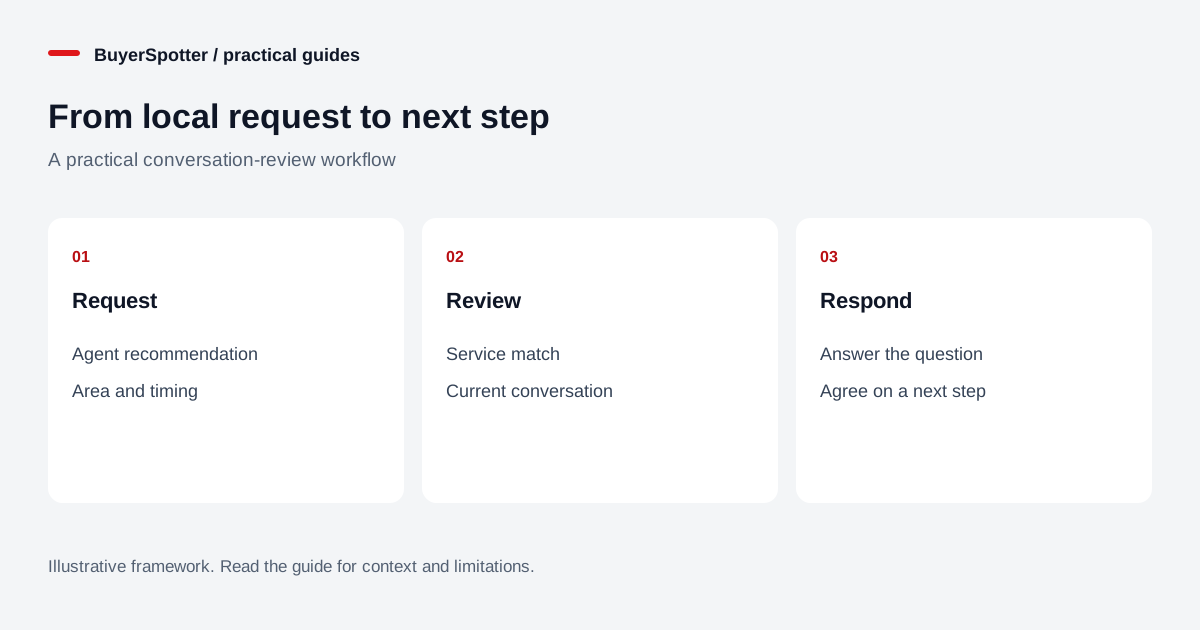
Read the diagram as text
- Request
- Agent recommendation
- Area and timing
- Review
- Service match
- Current conversation
- Respond
- Answer the question
- Agree on a next step

Choose communities with relevant requests
Read a recent sample from neighborhood, local business and relocation communities that your account can access. Look for questions you could answer usefully, not only the number of members. Check whether businesses may respond, whether promotions belong in a designated thread and whether the author returns to clarify their request.
Nextdoor describes Business Pages and local business participation as ways to establish a presence. A business profile and a monitoring workflow serve different purposes: one explains who you are; the other helps you notice a relevant conversation. Neither replaces reading the current community rules. Do not assume that access to a discussion gives permission to send everyone in it a private pitch.
Test phrases that express a request for help
Swipe sideways for more columns, if needed.
| Service | Example phrase to test | First review question |
|---|---|---|
| Home seller | recommend an estate agent | Which area and kind of help are they asking for? |
| Home buyer | looking for a buyer’s agent | Is the search active or early research? |
| Rental help | agent to help find a rental | Do you offer the requested rental service? |
| Property management | recommend a property manager | Does the property and service area fit your work? |
Adapt the terms to your market: people may say “real estate agent,” “estate agent,” “realtor” or a local-language equivalent. These are starting examples, not measured demand guarantees. Include actual phrasing from useful requests you encounter. Avoid adding every property-related keyword; a person advertising a room or discussing a mortgage is not necessarily asking for your service.
Separate current needs from future research
Open the original thread before deciding it is an opportunity. Check its date, newer comments and whether an agent has already been chosen. Note the stated location, service and timing. If any of these is missing, record it as unknown rather than filling the gap with an assumption.
Keep three simple review states: an explicit current request, early information gathering and not a service fit. A future seller researching how to choose an agent may appreciate an explanation but not an immediate appointment request. A renter needs a different response from a homeowner asking for a listing consultation. Treat each person according to the question they asked, not the commercial value you imagine they might have.
Offer a specific, transparent first response
Consider this fictional post: “Can anyone recommend an agent to help sell a flat in Northwood? We are starting to compare options.” A useful reply could be: “I’m an agent working in Northwood. When comparing agents, it can help to ask how they plan to present the property and keep you updated. Are you looking for an initial consultation, or still making a shortlist?”
The response identifies your connection, gives the reader something useful and asks a question that distinguishes their stage. It does not invent a price estimate or promise a sale. If the person invites a follow-up, agree on the appropriate channel and next action. Do not repeatedly contact someone who has not responded or treat a public question as blanket permission for outreach.
Measure the route from request to conversation
Keep a record with the original URL, request category, area, review date, what you actually sent and the agreed next step. Separate a replied-to post from a booked conversation, and separate both from a client engagement. This makes a small pipeline honest enough to improve.
Review why conversations stop. Wrong service area suggests a source problem. Many early-stage questions may call for a helpful guide instead of a harder pitch. Repeated requests outside your services suggest the phrases are too broad. Evaluate paid or shared lead sources using the same definitions, including review time and duplicate contacts, rather than comparing their headline lead counts with carefully qualified community requests.
Build a monitoring habit around your working day
Facebook group monitoring and Nextdoor monitoring can help you repeat a focused search without manually reopening every source. Start with a small selection, verify scan status and keep time available to review original threads. BuyerSpotter runs in desktop Chrome while Chrome, the connection and required source sessions are available. It does not keep scanning when your computer is off, and it never replies for you. Its Premium plan is $39 monthly or $390 annually, with a 7-day no-card trial that starts after the first successful live scan.
Use the opportunity checklist to qualify a request, then review the guide to useful local replies. Your aim is a reliable way to notice appropriate conversations, not a promise that every neighborhood post can become a client.
Sources and method
The Nextdoor business overview was reviewed on 15 November 2026. The phrases, example and review process are original editorial guidance. This article does not report conversion benchmarks or advise on property valuation, financing or legal requirements. Product scope and operating details are documented in the BuyerSpotter user guide.
Examples, sources and image method
Original worked examples and worksheets by BuyerSpotter. Requests and sample datasets are fictional. References are linked where used.