
Short answer
To find pressure washing leads, monitor local requests for driveway, patio and exterior cleaning, then qualify the surface, area, access, timing and services you actually offer. Use a clear assessment process and track estimates and accepted jobs rather than counting every mention of a pressure washer.
Get an alert when a neighbor asks for your trade. 7-day trial, no card needed.
Add to ChromeKey takeaways
- Customer wording often names the surface rather than the cleaning method.
- Separate requests to hire a service from equipment, rentals and DIY questions.
- Qualify scope and route fit before promising a price or appointment.
Define a service customers can recognize
Pressure washing lead generation gets clearer when the offer names the outcome and the property. A business might focus on driveway cleaning, patios, exterior house cleaning, or commercial premises. List the work you actually offer and the surfaces you need to assess before accepting. Avoid advertising every cleaning method simply because people search for it.
Write a service-area rule as well. A request outside your normal route can consume travel time that a local job would not. You may choose to review larger projects farther away, but define that decision before the inbox fills. A simple “usual area / case-by-case area / outside coverage” note is more useful than a vague promise to serve anywhere.
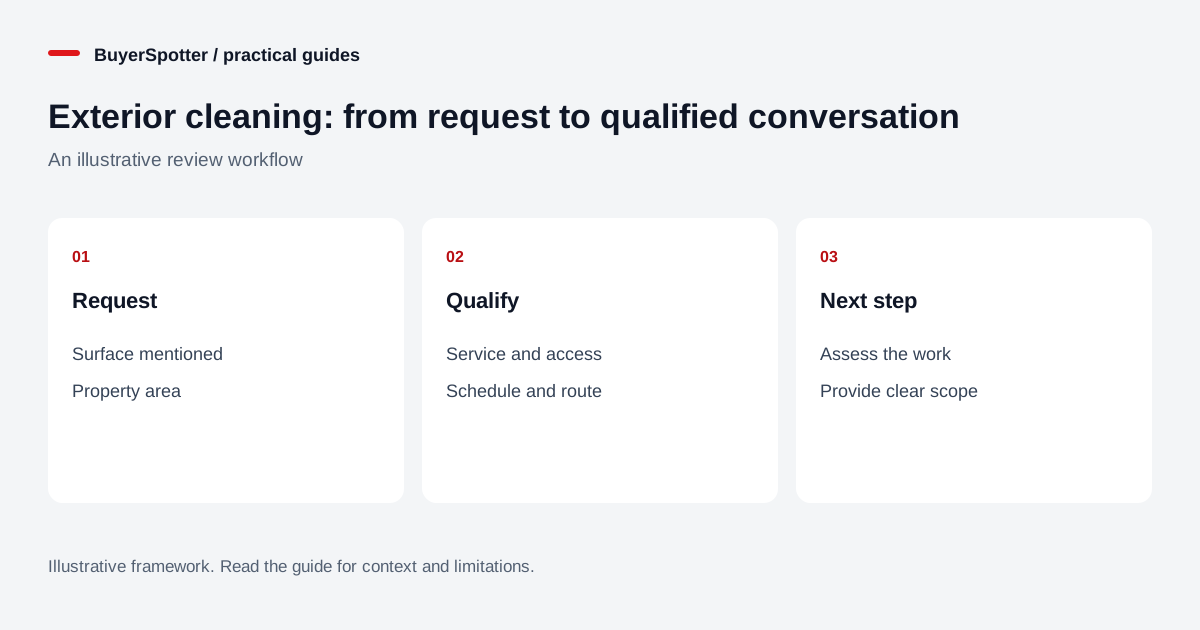
Read the diagram as text
- Request
- Surface mentioned
- Property area
- Qualify
- Service and access
- Schedule and route
- Next step
- Assess the work
- Provide clear scope

Listen for surfaces and situations
People may ask for “someone to clean the patio” without mentioning pressure washing. Build a phrase notebook around both the service name and the result. Keep the original request link when a phrase produces a useful match so you can explain why it belongs in the setup.
Swipe sideways for more columns, if needed.
| Example phrase | What to check |
|---|---|
| driveway cleaning | Hire request, surface and general area. |
| recommend pressure washing | Whether the author wants a provider or a machine. |
| patio needs cleaning | Service fit and current condition assessment. |
| exterior cleaning quote | Property type, scope and desired timing. |
Do not assume these phrases work equally well everywhere. Search manually first, read what they retrieve, and adapt to the language used in the communities you serve.
Remove equipment-shopping noise carefully
A post asking which pressure washer to buy is usually a different intent from hiring a cleaning company. A contractor recruiting workers, a rental recommendation and a homeowner requesting a quote can all contain the same trade words. Label these categories during review rather than trusting keyword presence alone.
Potential exclusions include obvious recurring equipment terms, but test each change. Excluding a manufacturer name might also remove a homeowner explaining what they previously tried before deciding to hire someone. Keep ambiguous posts in a separate review bucket. The goal is a useful selection of opportunities, not an empty inbox that merely looks precise.
For community searches, check both the original post and the latest replies. A person may have posted a before-and-after result, or already booked the work, even when the opening sentence still resembles a buying request.
Collect enough context for the next decision
Ask about the general location, the surfaces to be assessed, approximate scope, property access and preferred timeframe. A photograph can help arrange an assessment if the customer chooses to share one, but it should not become a basis for unsupported technical promises. Explain when you need an on-site review before confirming suitability or price.
Distinguish a small one-off cleaning request from recurring commercial maintenance. The latter may require a site contact, agreed service window and written scope. Keep those requirements separate so the same casual reply is not used for a household patio and a managed property.
Do not claim that a method is safe for every material or that all marks can be removed. This guide concerns finding and qualifying work; the contractor’s assessment determines the appropriate service.
Answer the project, not the keyword
Hypothetical request: “Who would you recommend to clean a driveway and small patio before our family visit next month?”
Example reply: “I run an exterior-cleaning business in the area. We assess driveway and patio jobs and provide a written scope before booking. If you are still looking, which neighborhood is the property in, and when would you ideally like the work completed?”
This reply establishes relevance without guessing a price. State the business connection, ask one manageable question and allow the buyer to choose the next step. Keep addresses and other private details out of the public thread. Respect group rules on commercial replies, and avoid pasting the same promotion under unrelated conversations.
Make source selection fit your actual route
Review neighborhood communities within your practical service area before adding distant citywide sources. A group’s size tells you little about whether it produces jobs you can serve. Read a recent sample and note the proportion of genuine hire requests, their general location, and how often authors return to answer questions.
Facebook group monitoring and Nextdoor monitoring can reduce repeated searching. BuyerSpotter runs in desktop Chrome while the browser and required access are available. It is not an always-on service, does not guarantee every request will be found, and never sends your reply for you. Open the thread before taking action.
Review estimates and outcomes, not just activity
Keep a small record with source, requested work, area fit, date reviewed, assessment offered, estimate sent, outcome and reason lost or declined. Mark an unanswered reply as unanswered, not as a qualified booking. Record travel or scheduling problems as well as price objections; those reasons can reveal that the source mix is wrong.
Compare monitoring cost and time with the accepted work that actually came from the channel. BuyerSpotter’s plans are $39 monthly or $390 annually, with a seven-day no-card trial beginning after the first successful scan. The trial is an opportunity to evaluate the workflow, not a promise of a particular number of jobs.
Examples, sources and image method
Original worked examples and worksheets by BuyerSpotter. Requests and sample datasets are fictional. References are linked where used.