
Short answer
Landscaping leads become useful when you identify the requested work, general location, project stage and timeframe. Monitor local recommendation requests, separate maintenance from design and installation, and offer an appropriate next step after checking your crew’s fit. Count assessments and accepted work, not every garden-related post.
Get an alert when a neighbor asks for your trade. 7-day trial, no card needed.
Add to ChromeKey takeaways
- Maintenance, garden cleanup and larger landscape projects need different qualification.
- People describe a garden problem before they know the name of the service.
- Check crew capacity and project fit before arranging a site visit.
Define the work your crew is set up to deliver
Landscaping can mean regular garden maintenance, seasonal cleanup, planting, design or a larger installation. Begin by writing the services your team accepts and the projects it does not. Include your usual area, how you handle requests farther away, and whether you currently have capacity for ongoing routes or only one-off projects.
This service map prevents a common problem: a large inbox with very few jobs that match the business. A maintenance crew should not spend its review time on major design enquiries it cannot quote. A design-led business should not treat every mowing request as a lost opportunity. Choose a pipeline that reflects the work you want to deliver well.
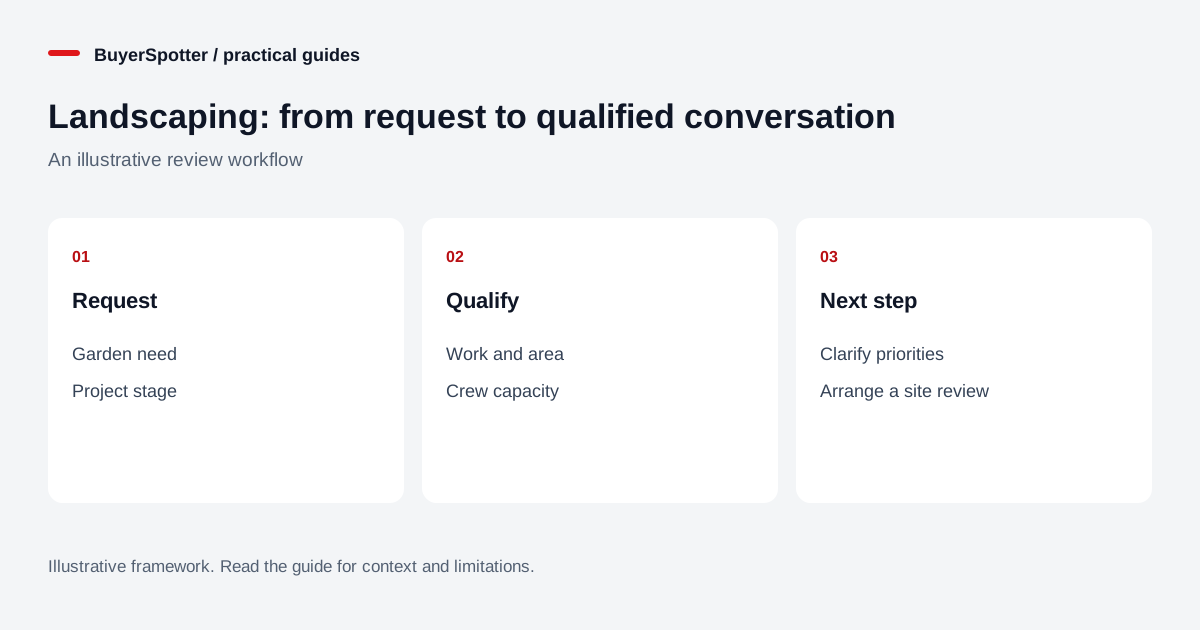
Read the diagram as text
- Request
- Garden need
- Project stage
- Qualify
- Work and area
- Crew capacity
- Next step
- Clarify priorities
- Arrange a site review

Translate the offer into customer wording
A customer may ask for “someone to sort out our garden” without knowing whether they need a gardener, landscaper or another contractor. Combine direct trade phrases with the situations your customers describe. Keep broad problem searches for review, because they can also retrieve hobby discussion or requests for free advice.
Swipe sideways for more columns, if needed.
| Phrase to test | Likely clarification |
|---|---|
| recommend a landscaper | Design, installation or maintenance? |
| garden cleanup | One-off scope, area and preferred timing? |
| regular garden maintenance | Frequency, property and route fit? |
| backyard redesign | Early ideas or ready for a professional assessment? |
These examples are a starting vocabulary, not a forecast of available projects. Adjust phrases using requests you actually review. Keep seller advertisements, recruitment and equipment discussions out of the qualified-lead count.
Choose communities with the right geography and property context
Start with accessible neighborhood and homeowner communities within your service area. Review recent posts to see whether members ask for providers and return to discuss their needs. A broad gardening community can teach you customer language without necessarily producing nearby projects. Do not confuse topic relevance with geographic relevance.
Read community rules before answering as a business. Some conversations invite recommendations; others are discussions among residents. When a source regularly produces unsuitable work, identify why: location, property type, project scale or rules on participation. Changing the source list may be more effective than adding increasingly complicated exclusions to every search.
Qualify the project before arranging a site visit
Ask what the customer wants to change, the general area, whether the work is a one-off project or ongoing service, and when they hope to begin. For a larger project, clarify whether they are collecting inspiration or seeking a provider to assess a defined brief. A photograph or sketch can support discussion if the customer chooses to share it, but it does not replace a site assessment.
Separate preferences from agreed scope. “Low maintenance” can mean different things to different households. Ask what they want less of and what they want to keep. If access, specialist work or another professional affects the project, explain that it needs review before confirming an offer.
Do not provide construction, drainage or plant-treatment advice as a shortcut to winning the enquiry. This process is about identifying a suitable conversation and arranging the appropriate professional review.
Offer a next step that matches the project stage
Hypothetical request: “We want to make our small backyard easier to look after. Does anyone know a landscaper who can help us work out a plan?”
Example reply: “I run a landscape business serving this area. We help with small-garden planning and can explain how our initial assessment works. Are you mainly looking to reduce regular maintenance, change the layout, or both?”
This reply makes the conversation more specific without promising a design, budget or result before assessment. Use it only if the service matches your real work. Disclose your business connection and avoid publishing a generic sales message under every garden post. If the author already has a provider, respect that outcome.
Connect monitoring to actual crew capacity
A useful opportunity still needs an owner. Decide who reviews requests, who confirms availability, and how an enquiry moves into your normal quoting process. Keep the original post link, a short summary and the next action together. Do not tell several people you can start immediately without checking the same schedule.
BuyerSpotter can monitor your chosen Facebook groups and Nextdoor area for matching requests. Desktop Chrome and the required source access must remain available; scanning is not an always-on cloud service. You review the match, read the current thread and reply yourself. Use the user guide to check setup and scan status.
Track project progress rather than a single lead total
Record the service category, location fit, project stage, response sent, assessment arranged, quote provided and final outcome. Keep recurring maintenance separate from installation projects. Their decision timelines and workloads differ, so one combined conversion figure may hide where the process is actually working.
Review rejection reasons and the time spent qualifying. A source with fewer but better-matched requests may suit your crew more than a busy citywide feed. BuyerSpotter costs $39 monthly or $390 annually; the seven-day no-card trial begins at the first successful scan. Read plan details and evaluate it against your own time and accepted work. No source or tool can guarantee a full schedule.
Examples, sources and image method
Original worked examples and worksheets by BuyerSpotter. Requests and sample datasets are fictional. References are linked where used.