
Short answer
To evaluate a request for a competitor alternative, identify why the author wants to switch, in their own words, and what the replacement must preserve, such as links, data or integrations. Test that requirement against your current product and the migration effort before replying, and state any gap plainly rather than repeating their complaint as fact.
Let BuyerSpotter watch your groups and searches for you. 5-day trial, no card needed.
Add to ChromeKey takeaways
- The reason for switching matters more than the competitor's name.
- "Too expensive" can mean a budget ceiling, a pricing unit that does not fit or unused features.
- A replacement must solve the complaint while preserving essential work, such as existing booking links.
- Make claims about a competitor only from its current official documentation.
- A complaint without a request to change may be venting or a support issue, not a sales opening.
Identify what must change
An alternative request gives you a useful starting point: the author knows an existing option and is considering another. Read the reason for the search. Price, missing functionality, support, complexity, or a changed workflow can each create a different requirement.
Write the reason in the author's words. "Too expensive" could mean a budget ceiling, a pricing unit that does not fit, or a feature the team rarely uses. Your lower headline price may not solve the underlying problem.
For how to spot these requests in the first place, see SaaS buying signals.
Separate what improves from what must survive the move
Worked example
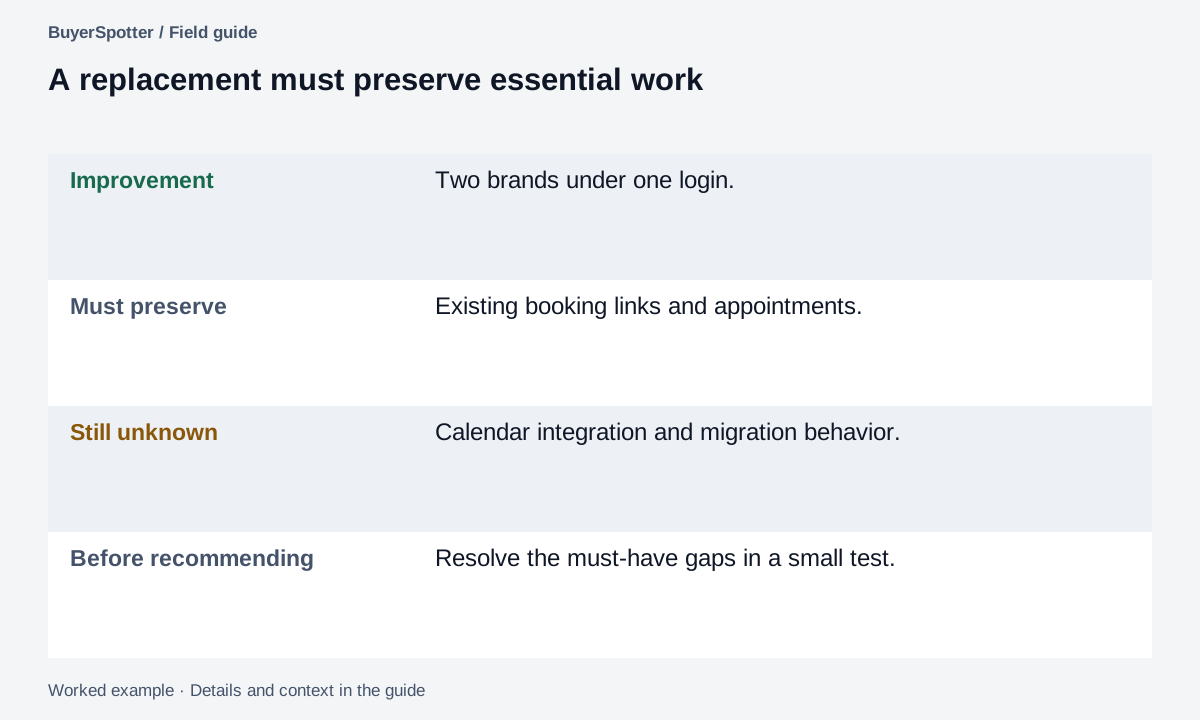
The scheduling team wants two brands under one login while preserving its booking links. Consider an unnamed replacement whose multi-brand support has been checked, but whose migration behavior has not.
Swipe sideways for more columns, if needed.
| Requirement | Status in this example | What to do |
|---|---|---|
| Two brands, one login | Supported in the evaluated configuration | Retain the settings and sample customer-facing flows |
| Existing booking links | Unknown | Inspect documented link ownership and migration options |
| Current appointments | Unknown | Check what imports, what stays in the original system and what needs manual handling |
| Required calendar integration | Not stated by the buyer | Ask which calendar workflow must remain intact |
| Effort to switch | Cannot yet be estimated responsibly | List the unresolved tasks before discussing a cutover date |
One green cell is not a replacement decision. If a must-have fails, a lower price does not repair it. If the buyer owns a short domain that points to the booking page, changing its destination may be worth investigating, but do not promise that this applies to vendor-owned URLs.
Read the example as text
- Improvement
- Two brands under one login.
- Must preserve
- Existing booking links and appointments.
- Still unknown
- Calendar integration and migration behavior.
- Before recommending
- Resolve the must-have gaps in a small test.

Test the constraint your product might fail
Example
"Any alternatives to our scheduling tool that support two brands without separate logins? We need to keep existing booking links working."
A competing scheduler might support multiple brands but lack a migration path for those links. That gap matters more than the shared category. A useful next question is how the links are distributed and what continuity the team needs.
Build a replacement checklist
Compare the requested workflow with your current capabilities, required integrations, data export and import needs, and the effort to move. Verify facts about your own product before responding. If you mention the other product, use its current documentation instead of repeating a complaint as a factual defect.
A specific tradeoff is more credible than a claim that your tool is better in every way. Explain where the fit is strong and which requirement needs checking.
For other software signals, use the SaaS example guide. Record any unresolved requirement in the opportunity checklist instead of assuming that dissatisfaction means readiness to buy.
Write a small switching test before recommending a move
A replacement should solve the complaint while preserving essential work. Use the author's stated requirement to design a small test with non-sensitive sample data. This is an editorial evaluation method, not a claim about any named competitor.
Swipe sideways for more columns, if needed.
| Scheduling requirement | Test | Evidence to keep |
|---|---|---|
| Two brands | Create a sample booking flow for each brand | The settings and customer-facing result |
| Existing links | Check the documented migration or redirection options | What can remain unchanged and what must be replaced |
| Booking continuity | Review how existing appointments and new bookings are handled | Any manual work, limitations, or unresolved questions |
When you cannot verify a requirement, list the unanswered question. An honest unknown gives the buyer a useful next step; an unsupported claim can make the suggested switch look easier than it is.
Write a recommendation that exposes the tradeoff
A useful answer can be short and still make the switching work visible. This example is a structure to adapt only after verifying the facts:
Worked example
"I work on [product]. It supports [verified requirement] in [the relevant plan or configuration]. I would check your booking-link setup before suggesting a move, because [documented limitation or unresolved question]. If keeping those links is essential, that test should come before comparing the rest of the features."
Compare that with "We do everything they do for less." The broad claim asks the buyer to trust an entire comparison that has not been made. The narrower answer tells them which part is known and where the decision could fail.
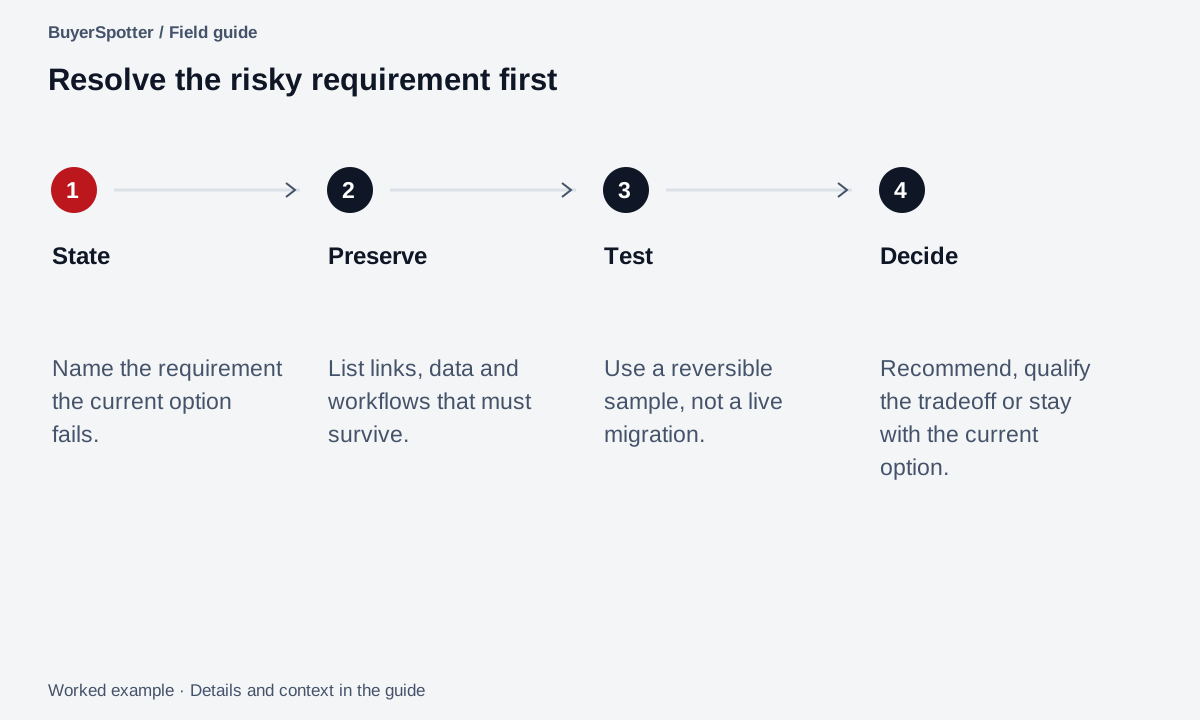
Use a reversible sample test before discussing a migration of live customer data. Record the starting setup, one representative workflow, the observed result and the remaining manual steps. If a required capability fails, stop the recommendation or describe the workaround and its cost clearly. Do not move the buyer's goalposts to make the alternative win.
Sometimes a settings change or a different plan from the existing provider solves the complaint with less disruption. Include that possibility when the evidence supports it. For a concrete example of comparing documented operating models rather than declaring a winner, see BuyerSpotter versus Syften. Use the blank replacement review below to distinguish the reason to switch from the work required to switch.
Read the example as text
- State
- Name the requirement the current option fails.
- Preserve
- List links, data and workflows that must survive.
- Test
- Use a reversible sample, not a live migration.
- Decide
- Recommend, qualify the tradeoff or stay with the current option.
Copy an alternative-request review
Current option: [named by the author]
Reason for considering a change: [exact wording]
Must preserve: [workflow, data, links, integrations]
Our verified fit: [current capabilities]
Our gap or tradeoff: [state plainly]
Migration question: [what must be checked]
Helpful response: [answer the requirement first]
Evidence for any comparison claim: [current source]
A complaint may have a simpler resolution
A complaint without a request for change may be venting or a support issue the current provider can solve. Do not treat negative sentiment as an invitation to sell.
Avoid claiming that a competitor cannot do something unless you have checked an authoritative source. An appropriate response can acknowledge that the existing option may still fit, especially when the cost of switching is larger than the stated problem.
Sources and method
Syften's buying-intent guide, reviewed 6 September 2026, includes alternative requests among its examples. That is a vendor's description of a request type, not evidence that dissatisfaction reliably predicts a purchase.
The scheduling scenario and switching test here are editorial methods using an unnamed example product. Any claim about a real competitor's capability, migration path, or price needs its own current authoritative source.
Frequently asked questions
How do I respond when someone asks for an alternative to a competitor?
Answer the stated requirement first, explain where your fit is strong and name any tradeoff. A specific, honest answer is more credible than claiming to be better in every way.
Is someone complaining about a competitor a sales lead?
Only if they are also looking for a change. Negative sentiment alone is not an invitation to pitch.
What should I check before suggesting a switch?
Current capabilities, required integrations, data export and import, and the effort to move. Record any requirement you cannot verify as an open question.
Can I say a competitor lacks a feature?
Only after checking an authoritative, current source. Otherwise describe what your own product does and let the buyer compare.
Examples, sources and image method
Original worked examples and worksheets by BuyerSpotter. Requests and sample datasets are fictional. References are linked where used.