
Short answer
BuyerSpotter is a Chrome extension that checks Facebook groups, Reddit, X, LinkedIn and Nextdoor through your own browser for $39 a month. Syften is an online service that lists Reddit, Hacker News, forums, X, GitHub, Slack communities and web pages, with plans from $29.95 a month. Choose by which sources your buyers actually use.
Let BuyerSpotter watch your groups and searches for you. 5-day trial, no card needed.
Add to ChromeKey takeaways
- BuyerSpotter covers Facebook groups (up to 25, member access), Reddit, X, LinkedIn and Nextdoor; Syften lists Reddit, Hacker News, forums, X, GitHub, selected Slack communities and web pages.
- BuyerSpotter runs in desktop Chrome and checks only while Chrome is open; Syften is an online account with stored filters.
- BuyerSpotter Premium is $39/month or $390/year; Syften publishes Entry at $29.95, Standard at $49.95 and PRO at $119.95 per month.
- Syften offers optional AI qualification on Standard and PRO; BuyerSpotter grades matches with rule-based buyer-intent signals.
- BuyerSpotter has a 5-day trial with no card; Syften lists a 14-day PRO trial with no card.
What this comparison can establish
This comparison is published by BuyerSpotter. Syften facts below come from its official buying-intent page captured on 6 September 2026. BuyerSpotter facts were checked against its product configuration and website on 7 September 2026. We have not run a side-by-side live detection test.
The first decision is whether each product can read the exact places your buyers use. The second is whether its operating model fits your work. A long source list or an attractive example cannot answer either question for your account.
Other comparisons: F5Bot, GummySearch and Devi.
The documented differences
Prices are USD and can change. This table compares published terms, not equivalent units of coverage or proven match quality.
Swipe sideways for more columns, if needed.
| Requirement | BuyerSpotter | Syften |
|---|---|---|
| Where it looks | Facebook groups (up to 25, member access, public or private), Reddit (all or chosen subreddits, no sign-in), X (Twitter) and LinkedIn searches through your signed-in Chrome, and Nextdoor within 1–80 km. Facts checked for version 0.8.14 on 26 September 2026. | Lists Reddit, Hacker News, forums, X, GitHub, selected Slack communities and web pages, among other sources. |
| Operating model | Chrome on desktop. Scheduled checks depend on browser availability, account access and source state. | Online account with stored filter configuration and alert delivery. |
| After a match | Review the post and match reason; open the original; Save, add a private note or mark Contacted locally. | Email and RSS; Slack and API on Standard/PRO; webhooks on PRO. |
| Filtering | Search phrases, exclusions and buyer-request criteria, with evidence to review. | Keyword filters; optional AI qualification on Standard/PRO. |
| Published price | Premium: $39/month or $390/year. | Entry: $29.95/month; Standard: $49.95/month; PRO: $119.95/month. |
| Selected limits | 10 search phrases, 25 selected Facebook groups, 2 active installations. Source availability applies. | Entry/Standard/PRO: 3/20/100 community filters and 100/200/500 community results per day. X and YouTube are paid add-ons. |
| Trial and access | 5 days, no card; starts after the first successful live scan. Check current installation availability. | 14-day PRO trial, no card; registration available on its website. |
Sources: Syften's published features and pricing; BuyerSpotter's plan details and browser and scan requirements. A filter, phrase and selected group are different units. Do not compare their counts as if they measure the same coverage.

Use hard requirements before comparing feature counts
Some requirements should end an evaluation rather than lower a score. If your chosen source cannot be reviewed, additional unrelated sources do not compensate. If the workflow must run while your desktop is off, a desktop-browser-dependent approach is not a substitute.
For the client-approval software example below, write four requirements before trying either product: exact communities to review, the no-account client workflow to recognize, the conditions under which checks must run, and the route by which a reviewer needs to see a result.
Worked example
Swipe sideways for more columns, if needed.
| Requirement | How to establish it | If it fails |
|---|---|---|
| A named source | Verify actual access and a completed review in the evaluated configuration | Stop if this source is essential |
| Checks under required operating conditions | Compare the documented operating model with your actual routine | Choose another workflow if the condition cannot be met |
| Original request and context | Open a result and inspect the underlying conversation | Do not accept an unexplained label as sufficient evidence |
| Required delivery route | Check the current plan and test the route you need | Include plan cost or incompatibility in the decision |
Syften's official page describes its sources and alert options; BuyerSpotter's workflow page describes its desktop-browser conditions. The published descriptions were reviewed on 7 September 2026. This requirement sheet still needs your own live observations.
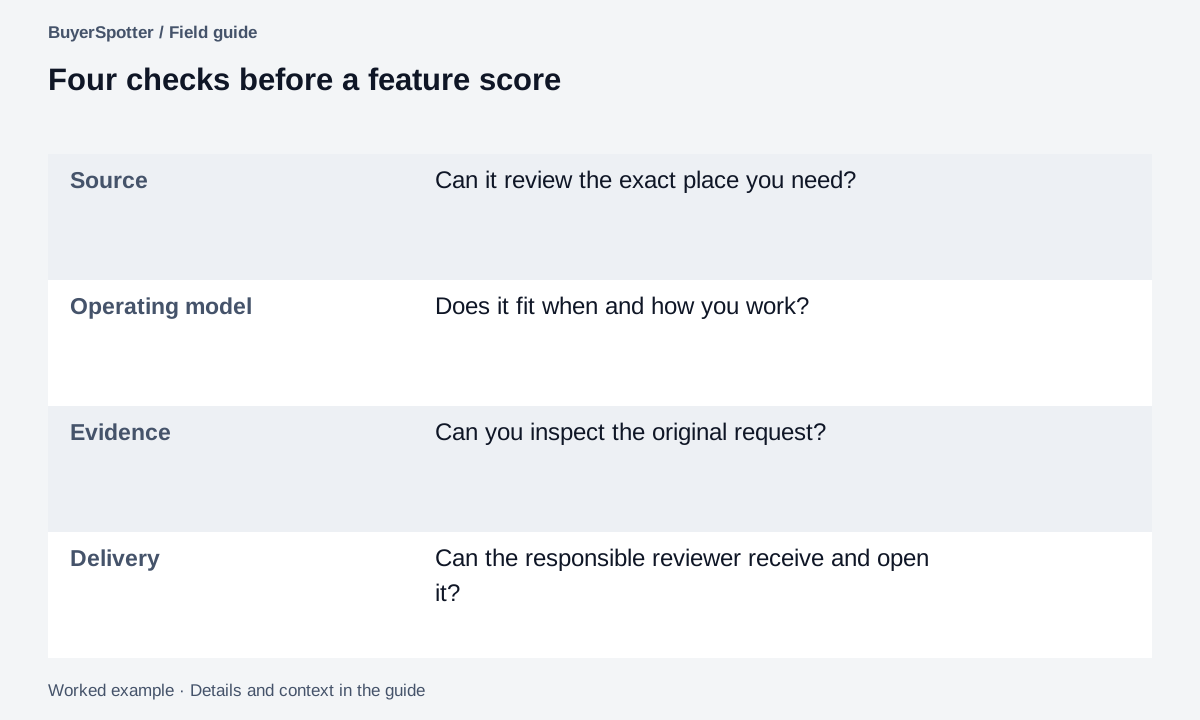
Read the example as text
- Source
- Can it review the exact place you need?
- Operating model
- Does it fit when and how you work?
- Evidence
- Can you inspect the original request?
- Delivery
- Can the responsible reviewer receive and open it?
Use one SaaS brief for both evaluations
Example
A founder sells client-approval software to small agencies. The target request asks for a tool that lets outside clients comment without an account. A generic discussion about team collaboration is too broad.
Use that same definition and a recorded source set in both evaluations. Label results useful, unclear, or irrelevant using the external-client requirement. Keep the product configuration and review dates with the results.
Compare the qualification work you will maintain
Record the phrases and exclusions behind each useful result. When a result fails, note whether the problem was the source, a broad term, a missing requirement or a resolved request. If you use an extra qualification step, check useful requests that it removed as well as weak ones it caught.
Keep the original wording beside your decision. For the client-approval example, look for the outside-client requirement rather than accepting a relevance label alone. The match-quality worksheet shows how to keep useful, unclear and irrelevant results separate.
This is a proposed evaluation method, not a published benchmark. Use similar dates, source scope and setup effort in both tools.
Run the same request brief, and record unknowns as unknowns
Worked example
Buyer: a small agency reviewing client-approval software. Required request: a person asks for a tool that lets outside clients comment without creating accounts. Poor fit: an internal team chat discussion with no external-client requirement.
Review record: product and plan; source list; configuration; review period; original result links; useful, unclear and irrelevant decisions; review time; source failures recorded separately.
Stop condition: an essential source is unavailable or the product cannot operate under the conditions the reviewer needs.
Use a small initial sample to make the labels consistent. If one reviewer accepts a broad "team collaboration" post and the other rejects it, resolve the definition before comparing totals. Keep that discussion in the notes. Otherwise a product difference may actually be a difference between reviewers.
Syften's filter tutorial, reviewed on 7 September 2026, demonstrates refining a search through the results it returns. Apply the same discipline to any configuration you test: retain one known useful case and one repeated mismatch, change one element, then examine a fresh sample.
There may be no reason to buy either product. A few manually reviewed sources may already meet your needs, or a basic alert may be sufficient. If local service-area qualification is the harder problem, use the local monitoring comparison as a second brief. Do not score an unavailable BuyerSpotter installation, an incomplete scan or an untested Syften feature as a passing result.
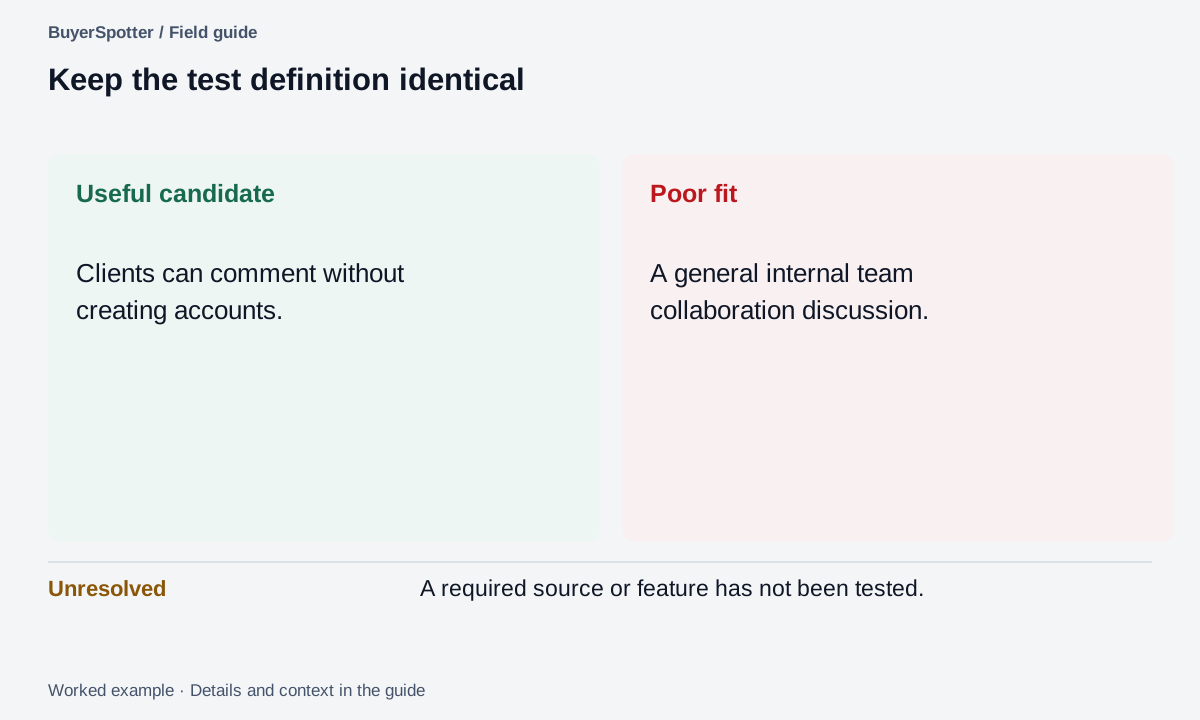
Read the example as text
- Useful candidate
- Clients can comment without creating accounts.
- Poor fit
- A general internal team collaboration discussion.
- Unresolved
- A required source or feature has not been tested.
Copy a comparison worksheet
Product evaluated: [name]
Qualification configuration: [phrases, exclusions, optional steps]
Date and configuration: [record]
Buyer request we want: [specific situation]
Sources required: [exact sources]
Sources actually tested: [record]
Known useful example: [link]
Useful / unclear / irrelevant results: [counts]
Review time: [minutes]
Evidence or workflow gap: [observed]
Current terms checked: [official page and date]
Choose based on the observed fit
Shortlist Syften if the public communities it lists and team alert channels match your requirements. Shortlist BuyerSpotter if you want to review accessible requests in a desktop-browser workflow and keep your own follow-up decisions beside them.
BuyerSpotter is not a fit for a requirement that checks must continue with your computer and Chrome closed. For either product, a missing required source is a reason to stop the evaluation rather than compensate with unrelated source count. Neither a matched conversation nor a saved opportunity establishes a sale.
Before committing, run the shared brief and record what happened. An unresolved scan or unavailable installation path is an evaluation limit, not a result to score.
Sources and comparison limits
The Syften column is vendor documentation, not independent verification. Recheck its official page for changes after the 6 September 2026 snapshot. BuyerSpotter's configuration and workflow were reviewed on 7 September 2026; actual platform access and scan completion were not tested for this comparison.
We have not measured relative detection speed, recall, review time or sales outcomes. Website examples are labeled illustrations. Use the source-selection exercise to write your requirements before trying either product.
Frequently asked questions
Is BuyerSpotter a Syften alternative?
For some teams. BuyerSpotter fits if your buyers ask in Facebook groups, Nextdoor, LinkedIn, X or Reddit and you work in desktop Chrome. Syften fits if you need the public communities it lists, such as Hacker News or GitHub, and team alert channels.
How do Syften and BuyerSpotter deliver alerts?
Syften lists email and RSS, with Slack and API on Standard and PRO and webhooks on PRO. BuyerSpotter sends desktop notifications, Telegram bot messages or webhook calls, and keeps every match in one inbox.
Which is cheaper, BuyerSpotter or Syften?
Syften's Entry plan is $29.95 per month and BuyerSpotter Premium is $39 per month or $390 per year. The plans limit different units, filters versus phrases and groups, so compare them against your required sources.
Does BuyerSpotter work when my computer is off?
No. It is a Chrome extension, not a cloud service, so checks run only while desktop Chrome is open. If you need checks with your computer off, it is not a fit.
Examples, sources and image method
Original worked examples and worksheets by BuyerSpotter. Requests and sample datasets are fictional. References are linked where used.
What we checked
Use the same standard for both products. Documentation explains the intended workflow; inspecting code can establish how a rule is implemented. Neither proves that your source was read or that a request became a customer.
Swipe sideways for more columns, if needed.
| Criterion | BuyerSpotter evidence | Syften evidence |
|---|---|---|
| Source access and operating conditions | Product-source and configuration review. Access to your chosen sources still needs a completed installed run. | Published source and workflow descriptions. No account-specific source test for this comparison. |
| Matching and fit | Code-reviewed keyword and request-signal rules. Service area, integrations and delivery capacity remain human checks. | Vendor descriptions of filtering and qualification. We have not run its matching process against the example set. |
| Interface and examples | Product components with fictional inputs; not a recording of live collection. | Vendor-published descriptions and examples; not our observed test results. |
| Detection quality or sales | Not measured here. | Not measured here. |
Source-review dates remain attached to the cited comparisons below. Unknown results are unresolved evaluation tasks, not a failing grade or evidence that a feature is absent.