
Short answer
Choose communities to monitor by where your buyers ask for help, not by size. Confirm your account can open the source, read its rules on commercial replies, inspect a consistent sample of recent posts, and record real requests and repeated mismatches. Then mark each source as active monitoring, occasional research, or excluded, with a review date.
Let BuyerSpotter watch your groups and searches for you. 5-day trial, no card needed.
Add to ChromeKey takeaways
- Audience fit matters more than member count; a smaller shop-owner group can beat a large peer group.
- A community full of your peers may be good for learning and poor for client requests.
- Access, participation rules and buyer fit are three separate checks.
- Visibility is not permission to promote; each platform and group has its own rules.
- Expand only after the current source set gives results you can explain.
Begin with where the buyer asks for help
List the places your existing customers use to ask questions related to your offer. A neighborhood group may fit a home service. A community organized around an industry or job may fit a SaaS team or specialist agency.
A community full of your peers may be excellent for learning and poor for client requests. Keep those purposes separate. The source should earn a place in your monitoring plan through observed conversations.
For Facebook specifically, see how to monitor Facebook groups for keywords; local businesses should also read local buyer-intent keywords.
Review the source before adding it
- Check that your own account can open the relevant content.
- Read the source's rules and look at how members actually respond to commercial requests.
- Inspect a consistent sample of recent posts.
- Record examples of useful requests and repeated mismatches.
- Decide whether the source belongs in active monitoring, occasional research, or neither.
Note the review date and sample size. A quiet period does not prove that a source never contains useful requests.
For Facebook-specific checks, see the group-review exercise. To compare the resulting matches later, keep the same labels used in the measurement worksheet.

Choose the relevant audience over the larger one
Example
A bookkeeping business compares a large national accounting discussion group with a smaller community of independent shop owners. The first sample contains technical debates and recruitment posts. The second contains questions about catching up overdue books.
The shop-owner community better matches this offer in the observed sample. The accounting group may still be useful for professional learning, so it receives a different role instead of being labeled a bad community.
Compare three filled source cards before adding more groups
These fictional source cards illustrate decisions for a retail bookkeeping service. The names are descriptive placeholders, not endorsements or claims about real communities. In your own cards, attach original post links and an actual review date.
Swipe sideways for more columns, if needed.
| Source | Observed sample in this example | Role | Reason |
|---|---|---|---|
| Independent shop-owner community | Requests for bookkeeping cleanup appear alongside retail operating questions | Active review candidate | The buyer and service overlap; access and participation rules still need checking |
| National accounting discussion group | Technical questions, training and recruitment dominate | Occasional research | Useful professional learning, but not the same customer-discovery task |
| General promotional listing group | Members mainly advertise their own services | Exclude from this request review | The observed sample does not justify repeated buyer-request inspection |
Do not turn these roles into permanent ratings. A source may change, or your service may change. "Exclude" means it does not earn time for this particular offer and task now. It does not mean the community has no value.
Keep a counterexample on each active card: the kind of apparently relevant post that should not be counted. For the retailer source, that could be a bookkeeping course promotion or a request for a full-time employee.
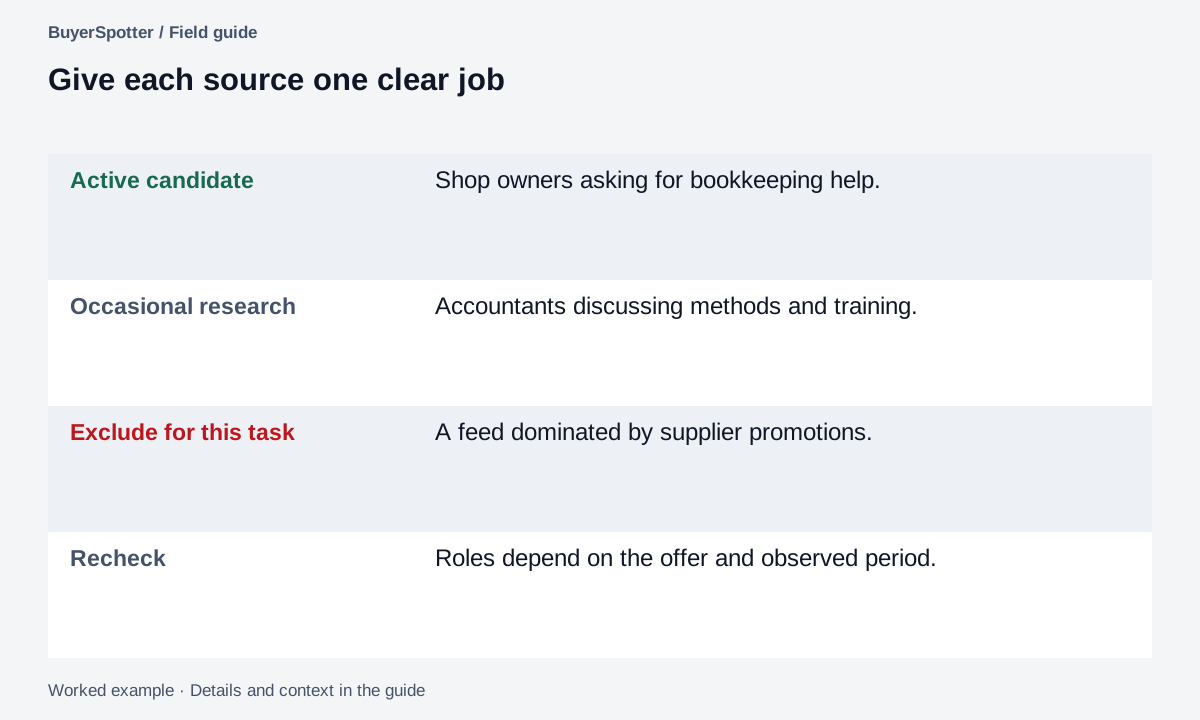
Read the example as text
- Active candidate
- Shop owners asking for bookkeeping help.
- Occasional research
- Accountants discussing methods and training.
- Exclude for this task
- A feed dominated by supplier promotions.
- Recheck
- Roles depend on the offer and observed period.
Give each source a purpose and review date
Write one sentence explaining why each source is included. When a source stops producing useful requests, inspect whether its activity changed, your offer changed, or your phrases became too narrow.
Expand after the first set is reviewable. Adding sources while the current results remain unexplained increases the volume of work without telling you what improved.
Set a review date and a reason to change the source list
A manageable starting schedule is more useful than a long list nobody reviews. The following is an editorial example, not a recommended scan frequency or a claim about product scheduling.
Worked example
- At setup
- Record the offer, source link, normal access, participation rules and the period inspected.
- At the next weekly review
- Check whether the active sources produced reviewable requests and whether repeated mismatches have a clear cause.
- At the next monthly source review
- Revisit occasional-research sources and decide whether their role has changed.
- Immediately after an access or rules change
- Pause assumptions about coverage or permissible responses until the new condition is understood.
Use a specific trigger for a change. Repeated requests outside the service area suggest a source-scope problem. A useful source producing only seller promotions under your phrase suggests a query problem. A source with an incomplete scan suggests an operational problem. Removing the source in all three cases hides the cause.
When you add a source, write what you expect it to contribute and when you will check that expectation. When you remove one, retain the reason and date. That makes it possible to reverse a poor decision without reconstructing the entire review.
Use the blank source card below, then test the first set with the group-review walkthrough. For local-service tool selection, bring those exact source requirements to the Narrative Field comparison; source count alone is not a decision.
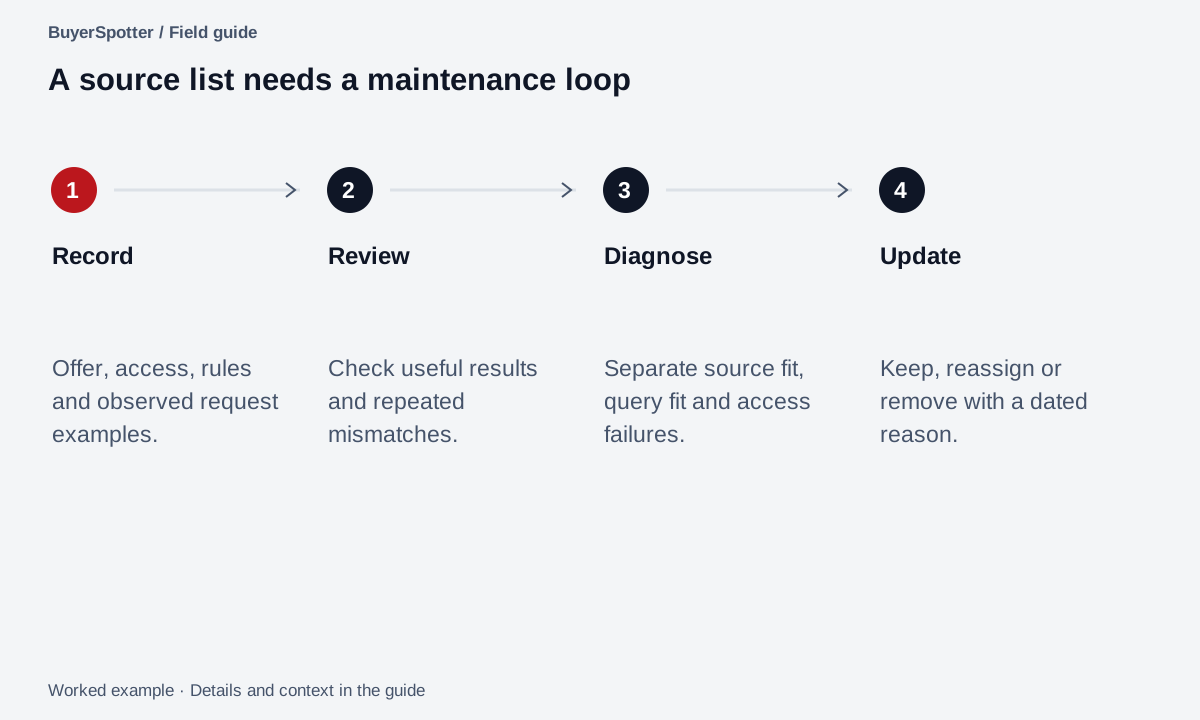
Read the example as text
- Record
- Offer, access, rules and observed request examples.
- Review
- Check useful results and repeated mismatches.
- Diagnose
- Separate source fit, query fit and access failures.
- Update
- Keep, reassign or remove with a dated reason.
Check visibility and participation separately
Facebook's group privacy guidance documents different visibility and participation conditions for groups. Check the group's current privacy, membership, and participation requirements. Visibility is not permission to promote. Source reviewed 6 September 2026.
Nextdoor has a more specific requirement for business promotion: its self-promotion guidance says replies promoting your own business must use a Business account. Keep each platform's requirements with that source instead of assuming one rule applies everywhere.
In our suggested source card, access answers whether you can inspect the conversation. Participation rules answer whether the intended response is appropriate. Buyer fit answers whether the request concerns work you can provide. A source belongs in active monitoring only when you have a defensible reason for its role, not simply because it is visible.
Copy a source selection card
Source name and link: [record]
Purpose: [buyer requests / market learning]
Buyer and offer overlap: [one sentence]
Access checked: [date]
Participation rules: [relevant constraints]
Sample reviewed: [period and count]
Useful request examples: [links]
Common mismatches: [observed]
Decision: [monitor / research occasionally / exclude]
Next review date: [date]
Treat coverage as an observation
Membership, access, and a configured source do not prove a successful scan. Verify the actual results and source status in the tool you use. A group that your account cannot access is not a candidate for bypassing access controls.
Do not choose communities solely because they permit promotion. A source can welcome vendors and still contain little demand for your service. Evidence of relevant requests should guide the decision.
Frequently asked questions
How do I find the best Facebook groups for leads?
Look for groups where your buyers ask for help, such as town or homeowner groups for local trades, then read a sample of recent posts for real requests. See how to monitor Facebook groups for keywords.
Should I join large groups or small niche communities?
Choose the one where your buyers post requests. A large group of peers often contains debate and recruiting, while a smaller group of your customers contains the questions you can answer.
How many communities should I monitor at first?
A small set you can review consistently. BuyerSpotter supports up to 25 Facebook groups, but starting smaller makes early results easier to explain.
Can I monitor a private group I am not a member of?
No. Only assess sources your own account can already open. BuyerSpotter reads private Facebook groups only when you are a member.
Examples, sources and image method
Original worked examples and worksheets by BuyerSpotter. Requests and sample datasets are fictional. References are linked where used.