
Short answer
Good buyer-intent keywords for a local business combine the service with request language such as "recommend" or "looking for", the problem in the customer's words, buyer context, location or timing, and exclusions for repeated mismatches like job ads. Test each phrase against real posts. The keyword builder drafts a starting list.
Let BuyerSpotter watch your groups and searches for you. 5-day trial, no card needed.
Add to ChromeKey takeaways
- A category word such as "roof" appears in ads, news, job posts and requests alike; add the situation around it.
- Build the map in six layers: offer, request, problem, context, constraint and exclusion.
- Write phrases from observed buyer language, such as "our books are behind", not how you describe your service.
- Keep a buyer request and a similar seller advertisement as a test pair for every change.
- BuyerSpotter accepts up to 10 search phrases plus exclusion words, shared across all networks.
A category word is only the starting point
The word roof can appear in a contractor's advertisement, a news story, a repair question, a job vacancy, or a homeowner's request for help. A useful keyword map adds the situation around the service.
Write phrases from observed buyer language. Your customers may describe water coming through a ceiling before they know whether they need roofing, plumbing, or another trade. Keep uncertain cases separate until you can identify the work.
Worked trade examples: electrician leads, painting leads and, for professional services, how to get bookkeeping clients.
Build five defensible starting phrases
For this exercise, imagine an outsourced bookkeeper who serves small retail businesses. The offer is cleanup and ongoing books, not personal tax advice, courses or recruitment. That boundary gives each starter phrase a purpose.
Worked example · fictional
Swipe sideways for more columns, if needed.
| Starting phrase | What it is meant to find | What can go wrong |
|---|---|---|
| recommend a bookkeeper | A person asking others to suggest a provider. | The buyer could need a service or location you do not cover. |
| books are behind | An owner describing a problem before naming the service. | It could be a general discussion with no request for help. |
| bookkeeping cleanup | A named task the business provides. | Courses and service advertisements use the same phrase. |
| looking for bookkeeping help | An explicit request for help with the work. | The author might want an employee, not an outside service. |
| retail bookkeeping | The buyer context and work together. | It describes a topic; it does not by itself express demand. |
These are five hypotheses, not five high-volume keywords. You do not have to use all five. A narrow phrase may be easy to interpret but miss different wording; a broader problem phrase may need more manual review. Keep the reason for each phrase so you know which one to revise when a mismatch repeats.
Location belongs in the fit check when it matters to delivery. Do not add a city to every phrase automatically: a post inside a local group may omit the city, while a post naming it may still describe work outside your scope.
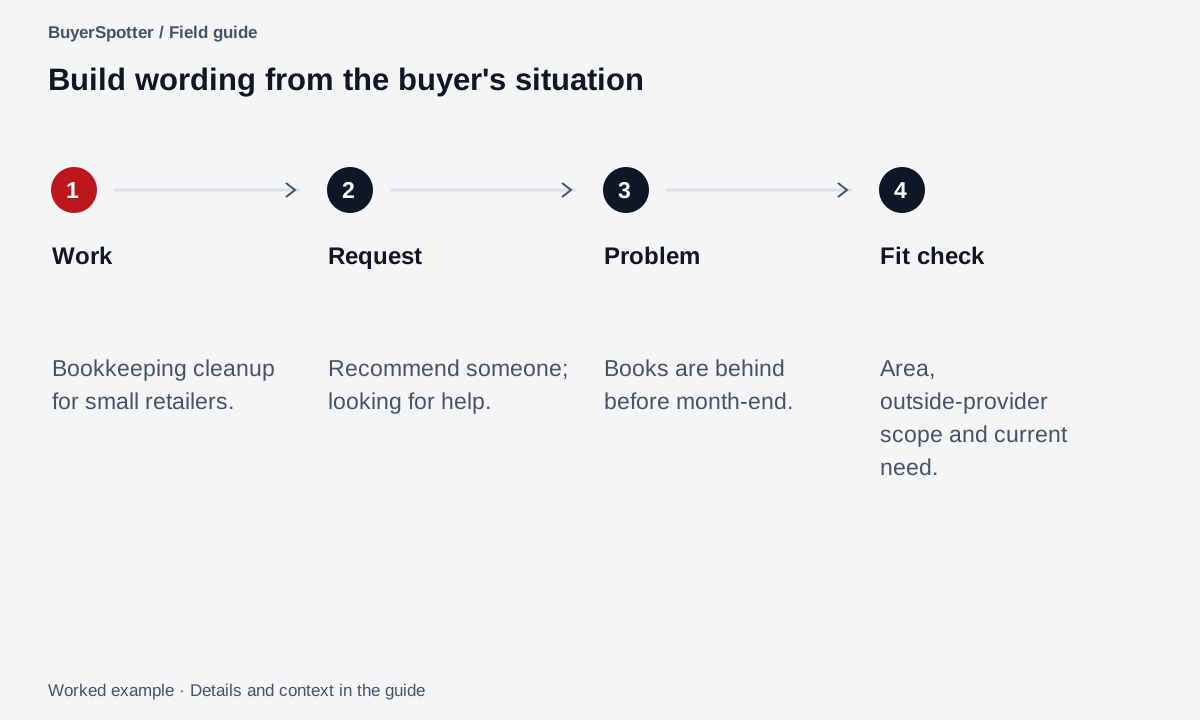
Read the example as text
- Work
- Bookkeeping cleanup for small retailers.
- Request
- Recommend someone; looking for help.
- Problem
- Books are behind before month-end.
- Fit check
- Area, outside-provider scope and current need.

Build the map in six layers
Swipe sideways for more columns, if needed.
| Layer | Question to answer | Example language |
|---|---|---|
| Offer | What work do you provide? | bookkeeping, payroll cleanup |
| Request | How does someone ask for help? | recommend, looking for |
| Problem | How do they describe the difficulty? | books are behind |
| Context | Which buyer fits? | small retailer, restaurant |
| Constraint | What affects the choice? | this month, bilingual, nearby |
| Exclusion | Which repeated results fail? | course ads, job vacancies |
The phrases are examples, not a product query syntax. Do not require every layer in every post. A clear request may need only a few of them.
The keyword builder turns those inputs into editable wording suggestions. It uses templates, not search-volume data or a hidden keyword database.
Compare your map with the guide's business-specific phrase examples, including a useful request, a noisy match and wording the first phrases could miss.
Test a map against opposite cases
Example
For an HVAC repair business, "AC repair" identifies the work and "available today" adds timing. A post asking for an available technician may fit; an advertisement announcing that a technician is available uses similar words but comes from the seller.
Keep the request and the advertisement as a test pair. A correction should separate them without excluding other legitimate ways a buyer asks for help.
Test difficult positives and negatives before adding exclusions
Keep a small fixed set of cases while you revise wording. For this example, a useful request asks for outsourced retail bookkeeping within the provider's area. These invented posts are for manual reasoning; their labels are not outputs from a live matching engine.
Swipe sideways for more columns, if needed.
| Case ID and example wording | Expected review label | Reason |
|---|---|---|
| P01: Can anyone recommend a bookkeeper for our North Austin shop? | Useful | Provider request, business context and area fit. |
| P02: Our North Austin shop's books are behind. Who handles retail cleanup? | Useful | Problem language accompanies a request for a provider. |
| N01: Bookkeeping cleanup course starts Monday. | Irrelevant | Training promotion rather than a provider request. |
| N02: Bookkeeper job vacancy: permanent in-house role. | Irrelevant | Employment, not outsourced service. |
| U01: The books are behind again. What a week. | Unclear | An active request and scope are missing. |
| P03: Our bookkeeper is training a replacement. We need temporary retail cleanup help in North Austin. | Useful | Training appears in a request that fits. |
| P04: I took a bookkeeping course but need someone to clean up our North Austin shop's books. | Useful | Course appears in a genuine request for outside help. |
| N03: Recommend a bookkeeper for our shop; weekly on-site work in Dallas is required. | Irrelevant | A genuine buyer request outside this offer's service area. |
Excluding training would lose P03. Excluding bookkeeping course would lose P04. N03 cannot be solved by assuming all recommendation requests fit. Its required location changes the decision even though its buyer language is strong.
Worked example · fictional
Swipe sideways for more columns, if needed.
| Manual exclusion check | N01 course advertisement | P03 replacement request | P04 course-to-help request |
|---|---|---|---|
| Reject text containing course | Rejected | Preserved | Wrongly rejected |
| Reject text containing course starts | Rejected | Preserved | Preserved |
This before/after table uses literal text inclusion as a teaching rule. It was checked against the written cases above, not run through BuyerSpotter or a platform search. It suggests a narrower candidate to test; it does not establish improved product precision. Other wordings may still escape the narrower rule.
Record one change, rerun the same useful and unwanted cases in the available controls, then review a new bounded source sample. Keep your expected labels separate from observed outcomes. The noise-reduction exercise explains the next review.
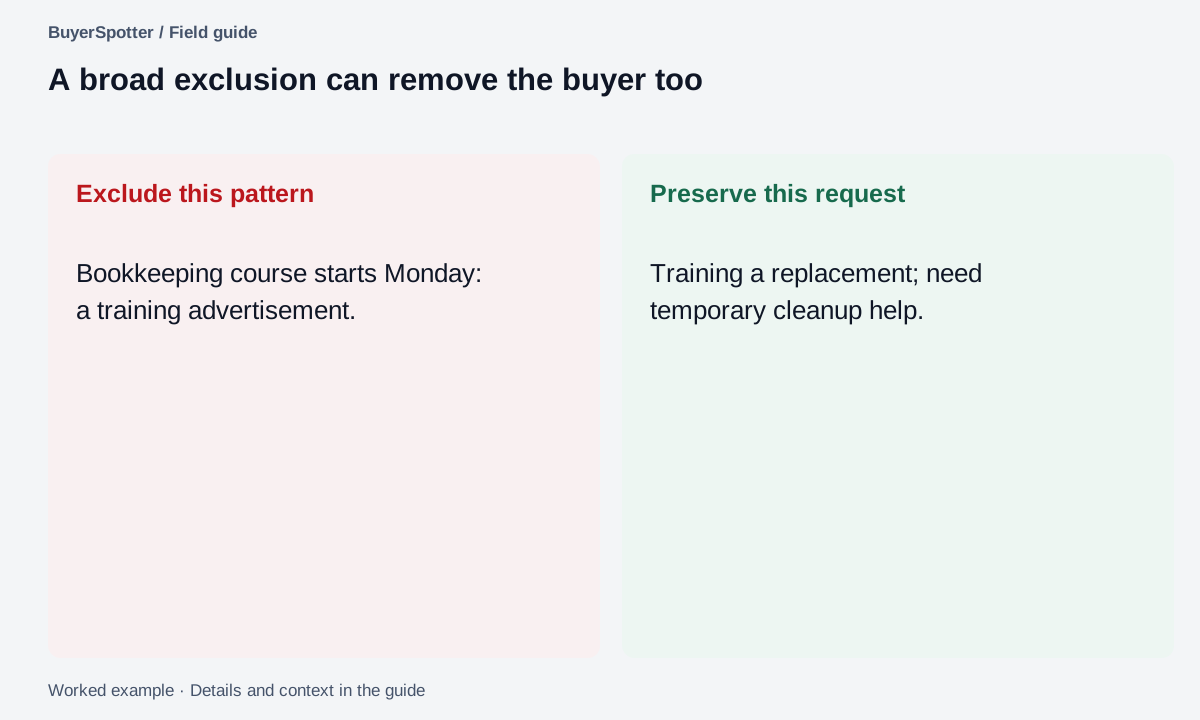
Read the example as text
- Exclude this pattern
- Bookkeeping course starts Monday: a training advertisement.
- Preserve this request
- Training a replacement; need temporary cleanup help.
Translate the offer into several ways of asking
The examples below are starting material for a phrase notebook. They are not measured high-volume search terms, and they are not instructions for a particular product's query parser.
Swipe sideways for more columns, if needed.
| Offer | Example buyer wording | Context to verify |
|---|---|---|
| Bookkeeping cleanup | Our books are behind; who can help before month-end? | Business type and cleanup scope |
| Electrical repair | Can anyone recommend someone for an older house? | Requested electrical work and service area |
| Commercial cleaning | Looking for cleaners before our office opens | Property size, schedule, and one-time versus ongoing work |
| Website migration help | Need someone to check tracking before we move the site | Technical stack, deadline, and review scope |
Replace an example phrase when your source review reveals better wording. Keep the original post link next to the phrase so you can explain its origin. A growing list without examples behind it is harder to maintain than a short map of observed language.
Move a phrase notebook into a focused setup
The free phrase builder can help you draft wording. Treat its output as text to review, not a query you must paste in full. Remove phrases for services you do not provide and separate unrelated buyer situations.
Worked example · fictional
Offer: retail bookkeeping cleanup. First phrases to evaluate: recommend a bookkeeper, books are behind, bookkeeping cleanup.
Possible exclusion to test: course starts, only after that exact unwanted pattern appears in your results. Preserve: the training-replacement and course-to-help requests above. Fit questions: outside provider acceptable, service area, records involved.
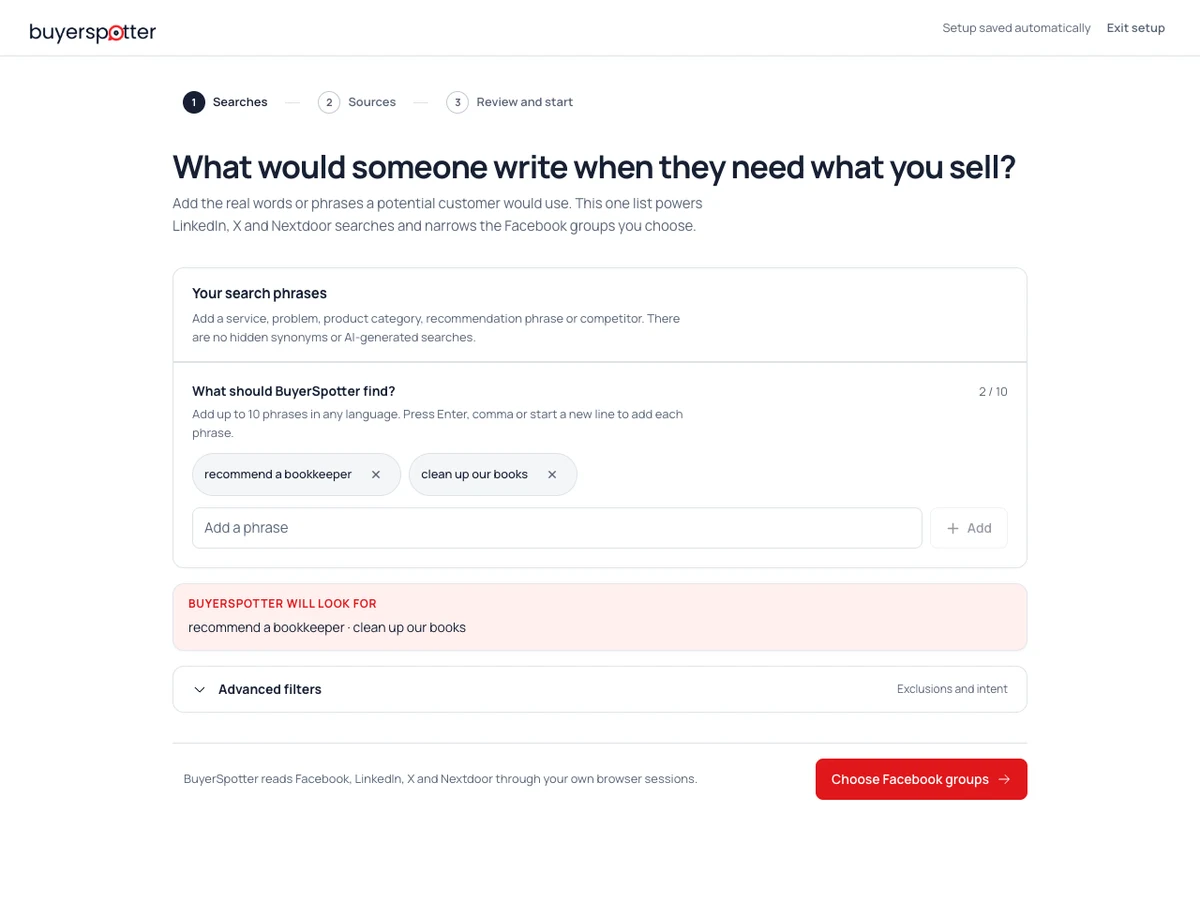
In BuyerSpotter's code-reviewed first-time setup, enter phrases under Your search phrases; exclusions are under Advanced filters in Always ignore. To edit them later in the workspace, open Searches & schedule, choose Edit, and use Look for and Always ignore. Enter phrases separately rather than pasting a table, explanation or invented Boolean syntax. The first-week guide explains the current labels and the checks still needed in your installed version.
Keep your phrase notebook outside the tool as well. It preserves why a phrase exists and which example supports it. If the first review produces few results, check source completion and inspect some original posts before assuming the wording is wrong.
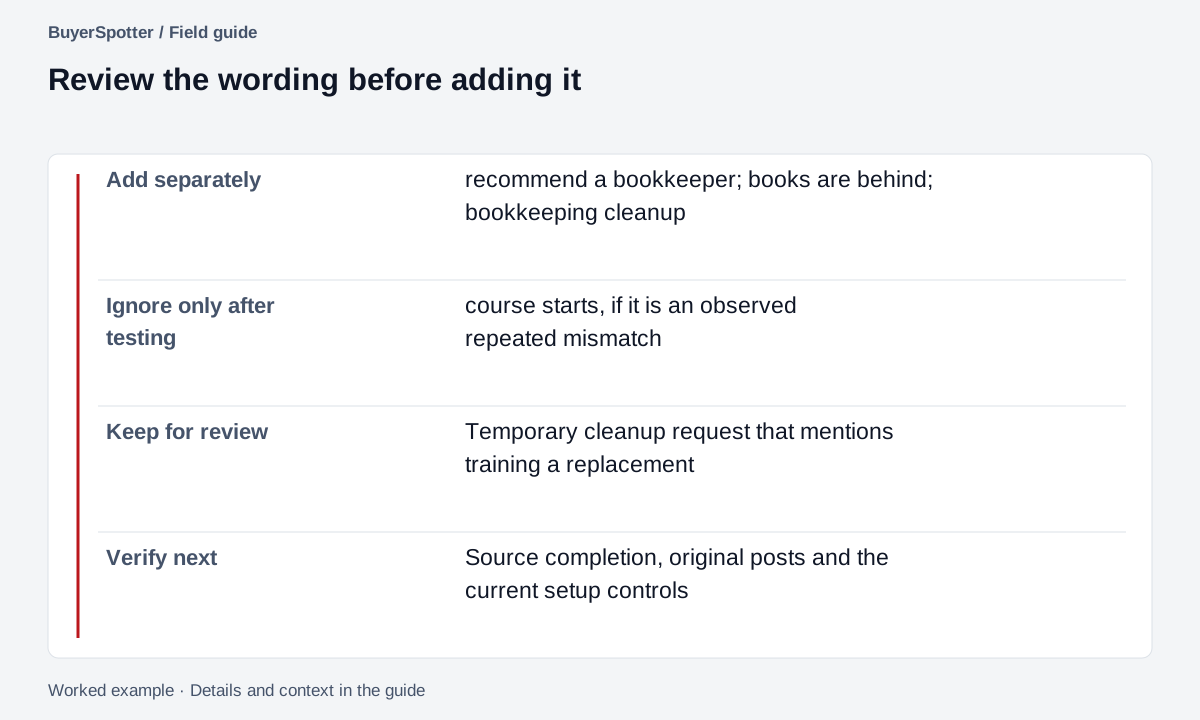
Read the example as text
- Add separately
- recommend a bookkeeper; books are behind; bookkeeping cleanup
- Ignore only after testing
- course starts, if it is an observed repeated mismatch
- Keep for review
- Temporary cleanup request that mentions training a replacement
- Verify next
- Source completion, original posts and the current setup controls
Enter the phrases you actually want to test
Example phrases: recommend a bookkeeper; clean up our books.
Copy a phrase planning sheet
Offer words: [work you provide]
Request phrases: [words buyers use]
Problem descriptions: [symptoms before the category name]
Buyer context: [industry or situation]
Area and timing: [constraints that matter]
Observed exclusions: [specific repeated mismatches]
Known useful example: [link]
Similar irrelevant example: [link]
Change to test: [one adjustment]
Download the phrase-testing worksheet
Download phrase-testing.csv. The file is blank apart from headings. Use one row per case and configuration so you can compare the same case before and after one change.
Record anonymous case IDs, expected labels, the phrase or exclusion being tested, and the actual result. Use Test method to distinguish manual text review from an observed product run. An expected label is your judgment; Observed outcome stays blank until you perform that check. Record the version and test date for a product run.
Keep private post text and any ID-to-link mapping in separate private notes. The CSV does not send data back to BuyerSpotter. After checking the difficult cases, use the quality worksheet for a new source sample rather than reporting your hand-picked test set as a market benchmark.
Separate requests from problem discussions
A direct request, an urgent problem, and frustration with a provider need different interpretation. Combining them into one long query makes false positives harder to diagnose.
Platforms and products can interpret phrases differently. Test the search or monitoring controls you actually use; do not assume a planning sheet is a Boolean expression you can paste unchanged. Keep useful posts with unexpected wording so your vocabulary can improve.
Sources and method
Syften's buying-intent guide, reviewed 6 September 2026, describes keyword filters, optional AI qualification, and recommendation, alternative, and problem examples. It provides a vendor reference for separating kinds of requests.
The six-layer map and phrase library here are editorial starting points. They have not been ranked by measured search volume. Replace illustrative phrases with wording you observe in relevant posts and test them in the controls you use.
Frequently asked questions
What are buyer-intent keywords?
Phrases people use when they are asking for help, such as "can anyone recommend a plumber" or "looking for a bookkeeper", rather than general words about a topic.
Should I include my town or neighborhood in keyword phrases?
Only where it improves fit. Many buyers do not name a place, so a monitored local group or a Nextdoor radius often handles geography better than the phrase.
How many keywords should a local business monitor?
Start with a few phrases you can review consistently and add wording you observe in real requests. BuyerSpotter allows up to 10 phrases plus exclusions.
Which exclusion words help local keyword alerts?
Add exclusions only for mismatches you have seen repeat, such as "hiring" for job vacancies or a word that appears in course ads.
Examples, sources and image method
Original worked examples and worksheets by BuyerSpotter. Requests and sample datasets are fictional. References are linked where used.
Screenshots show the real BuyerSpotter interface with fictional requests. They illustrate the controls, not a live scan. Product version 0.8.6. Screenshots show the current interface with example data.
A wording exercise, not keyword-volume research
This guide builds phrases for a bookkeeper's monitoring setup. These are words to test against community posts, not measured SEO queries. The phrase list, posts and before/after cases below are fictional teaching material. No search volume, live scan or product-accuracy result was measured for them.
The setup image shows BuyerSpotter 0.8.6 components rendered on 7 September 2026 with sample values. It supports the field labels and visible input sequence. It does not prove how every phrase will behave in your installed version or that a source was checked. Test the selected controls with your own accessible scope before relying on them.