
Short answer
To find useful roofing leads, define the work and service area your business covers, monitor explicit local requests and review the current thread before responding. Clarify the requested assessment, timing and decision process without diagnosing a roof from a post. Measure arranged assessments and completed work separately from alerts.
Let BuyerSpotter watch your groups and searches for you. 7-day trial, no card needed.
Add to ChromeKey takeaways
- Separate repair, replacement and inspection requests.
- Check service area and actual capacity before offering an appointment.
- Treat a public post as the beginning of qualification, not a remote diagnosis.
- Compare paid lead sources and community requests using the same outcome definitions.
Write down what counts as a useful roofing lead
A roofing business may focus on repairs, planned replacements, commercial maintenance or particular roof systems. Define the work you can accept before setting up a search. Include your service area, assessment process and realistic capacity. A request outside that boundary can be a genuine customer need without being a useful opportunity for your team.
Separate an explicit request for a roofer from general discussion about roofs. A homeowner comparing future options is at a different stage from someone asking who can assess a current problem. Neither should be mislabeled to make the lead count larger. The practical question is what the author needs next and whether you are equipped to provide it.
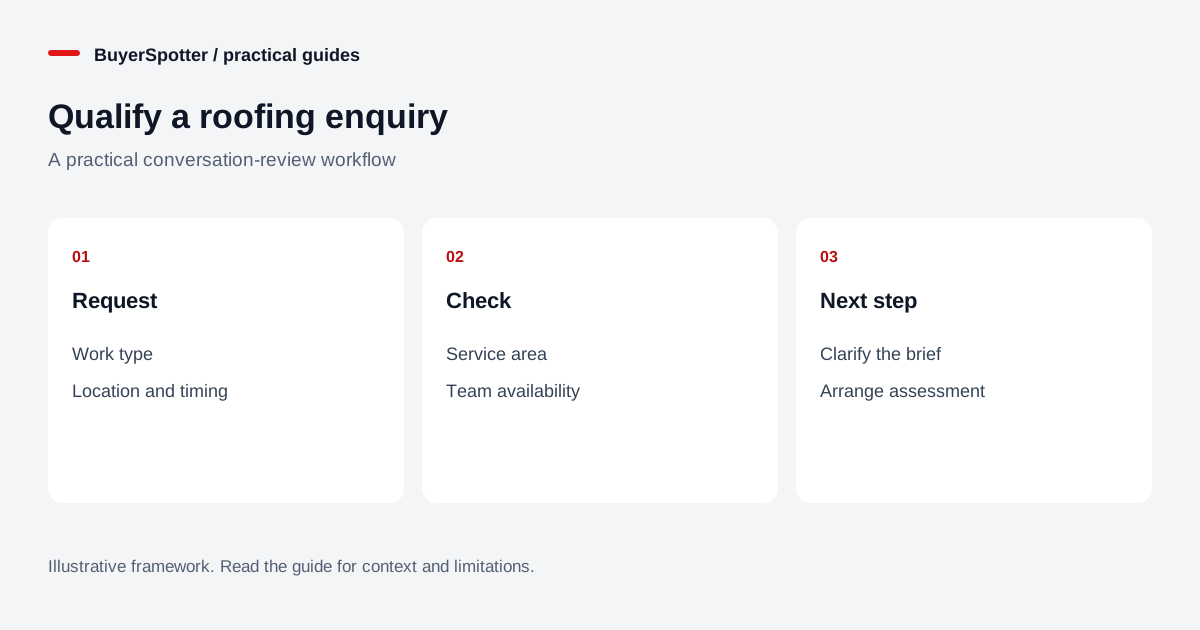
Read the diagram as text
- Request
- Work type
- Location and timing
- Check
- Service area
- Team availability
- Next step
- Clarify the brief
- Arrange assessment

Compare community requests and paid leads fairly
Paid lead services, referrals and local community conversations bring different amounts of context. Before buying a lead package, ask what the vendor means by a lead, whether the enquiry is shared, how duplicates are handled and what information is included. Treat the answers as plan-specific details to verify, not assumptions about the whole category.
Community requests let you inspect the wording and discussion, but someone still needs to find and review them. “Free roofing leads” can therefore mean no charge for each request, not zero cost in software or working time. Compare channels using relevant enquiries, assessments arranged and completed jobs, with the same definition for each stage. Raw contact totals are not a fair comparison.
Search for the work a homeowner is requesting
Swipe sideways for more columns, if needed.
| Request type | Example phrase to test | Useful next check |
|---|---|---|
| Repair assessment | recommend a roofer | What kind of help is being requested, and where? |
| Planned replacement | roof replacement quote | Is the person researching or arranging assessments? |
| Inspection | looking for a roof inspection | Does the requested inspection fit your services? |
| Commercial work | commercial roofing contractor | Does the building and scope fit your team? |
Adapt these examples to your actual services and local terminology. Test them against recent posts before enabling a broad source set. The word “roof” alone may produce property advertisements, DIY discussions, employment posts and sellers promoting materials. Keep a few useful and misleading examples so you can evaluate phrase changes later.
Review the thread without making a remote diagnosis
Check the post date and recent comments. The author may already have arranged a visit, clarified the type of work or changed the requested timing. Record only what is stated. If the general area or requested service is missing, leave it unknown and ask for the information through an appropriate next step.
A photograph or brief description is not a completed professional assessment. Do not use a monitoring alert to declare that a roof needs replacement, promise an insurance outcome or give repair instructions. The marketing task is to recognize a request and offer a suitable assessment process. Technical findings should come from the qualified professional carrying out that process.
The National Roofing Contractors Association’s contractor-selection guidance highlights references and a clear written scope. Be ready to explain your assessment and proposal process, rather than relying on an impressive-sounding reply alone.
Respond with your scope and a practical question
Consider a fictional post: “Can anyone recommend a roofer in Westbridge? We want a quote for replacing the roof later this year.” A relevant reply might be: “We handle roof replacement assessments in Westbridge. Are you looking to arrange visits now or gathering options for later? I can explain our assessment process if that would help.”
This identifies the business connection and separates active scheduling from research. It does not promise a price or availability before checking. For a repair request, explain whether your team handles the stated work and what the assessment process involves. If your schedule is full, say so. A fast answer is only useful when the commitment behind it is accurate.
Keep monitoring aligned with the team’s capacity
Use neighborhood sources where people ask for contractor recommendations and where commercial participation is appropriate. Read the community rules and avoid repetitive replies across unrelated threads. If demand rises after a local event, check current capacity before increasing outreach. Never imply a guaranteed response time just because the request appears urgent.
Facebook group monitoring and Nextdoor monitoring can help reduce repeated searches. BuyerSpotter runs in desktop Chrome while Chrome, the connection and required source sessions are available. It does not keep scanning when your computer is off, and it never replies for you. Its Premium plan is $39 monthly or $390 annually, with a 7-day no-card trial that starts after the first successful live scan. An alert can identify a conversation worth reviewing; it cannot guarantee access to every request or establish whether the work is technically suitable.
Track the decision after the enquiry
Use a short record with the source URL, stated work, service-area fit, review date, response sent, assessment arranged, quote issued and outcome. Keep “no response” and “outside scope” as valid outcomes. Do not count a copied draft, an opened post or a scheduled reminder as a conversation with a customer.
Review the reasons opportunities are declined. If the same distant area appears repeatedly, change the source mix. If many requests concern work you do not handle, tighten the brief. If relevant enquiries reach the quotation stage but do not progress, review that process separately. Monitoring can improve discovery; it does not replace estimating, scheduling or service delivery.
Sources and method
The examples and qualification process are original editorial marketing guidance. They contain no roofing repair advice, performance statistics or customer testimonials. NRCA’s contractor-selection guidance and Nextdoor’s business overview were reviewed on 15 November 2026. Product requirements are explained in the BuyerSpotter guide; the opportunity checklist provides a reusable next step.
Examples, sources and image method
Original worked examples and worksheets by BuyerSpotter. Requests and sample datasets are fictional. References are linked where used.