
Short answer
To get photography clients from community requests, choose a photography specialty, monitor how clients describe that shoot and check the date, location, usage and deliverables. Respond with a relevant portfolio example and one question that helps define the brief, then track actual enquiries and bookings.
Let BuyerSpotter watch your groups and searches for you. 7-day trial, no card needed.
Add to ChromeKey takeaways
- Create separate searches for weddings, portraits and commercial projects.
- Confirm the date and location before investing in a detailed proposal.
- Match portfolio examples to the requested work.
- Distinguish a photographer hire request from camera shopping, recruitment and general advice.
Lead with the kind of shoot you want to book
A photographer who wants commercial product work should not judge a marketing channel by the number of wedding enquiries it produces. Start by defining the work you accept, the area you serve and your availability. Include practical constraints such as whether you travel, work in a studio or can accommodate a requested turnaround.
Build separate briefs for different services. A wedding enquiry depends heavily on the date and event coverage. A business portrait session needs a plan for the people and location. Product photography involves the items, visual style and intended deliverables. One generic “photographer” alert cannot express all of these differences, though it can be useful during an initial research pass.
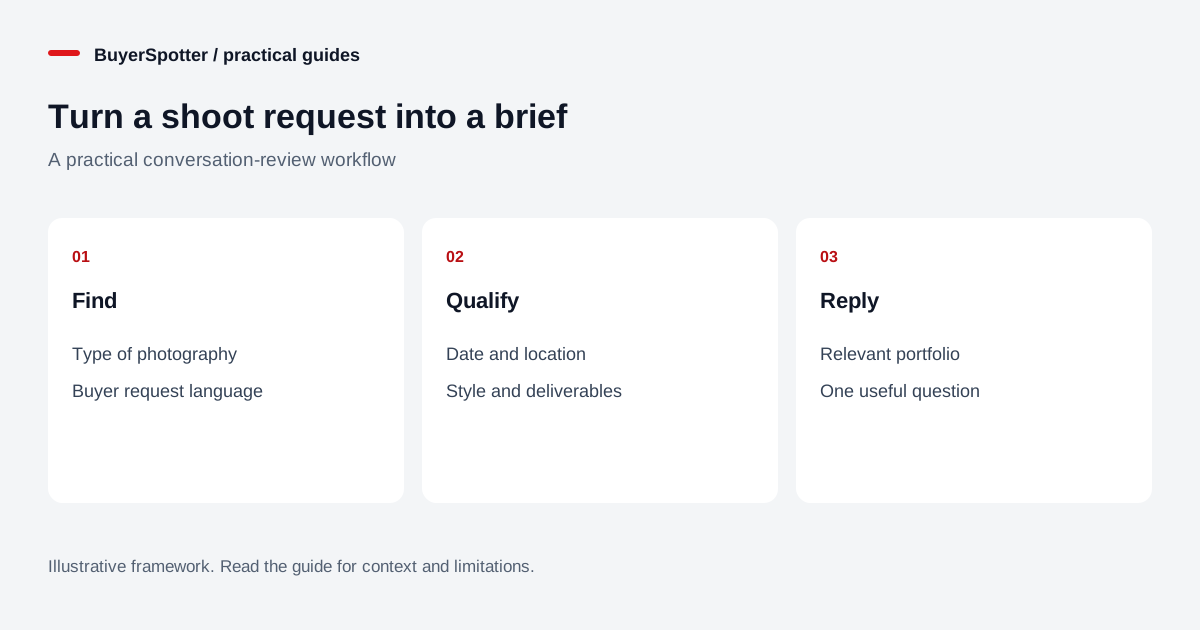
Read the diagram as text
- Find
- Type of photography
- Buyer request language
- Qualify
- Date and location
- Style and deliverables
- Reply
- Relevant portfolio
- One useful question

Look where clients describe the project
Read recent requests in relevant local communities, business-owner groups and communities connected to the events or industries you serve. Notice how a client describes the job before they know the technical terminology. A shop owner may ask for “better pictures for our website” rather than “commercial product photography.” That phrasing can be more useful to test.
Check the rules about business replies and portfolio links. Some communities have dedicated recommendation threads, while others are intended only for peer advice. You can learn from a source even if it is not an appropriate place to pitch. Keep your profile and portfolio clear enough that an interested person can understand your work without searching through unrelated material.
Professional Photographers of America’s customer-focused marketing discussion emphasizes explaining the work in language that reflects the customer’s priorities. Apply that idea to the project brief: describe what the client needs to achieve, then show relevant work.
Build phrases around distinct project types
Swipe sideways for more columns, if needed.
| Project | Example request phrase | What to qualify |
|---|---|---|
| Wedding | wedding photographer available | Date, location and coverage needed |
| Business portraits | photographer for team headshots | Number of people and location |
| Products | need product photos | Items, style and intended use |
| Local event | recommend an event photographer | Event schedule and delivery expectations |
These are illustrative phrases, not proven top-performing searches. Test them against recent posts and refine using real wording. Keep camera-shopping questions, photographer job applications and collaboration requests separate from paid client enquiries. A collaboration can be worthwhile, but it should not silently inflate your count of potential bookings.
Use five checks before preparing a proposal
Date: establish whether the shoot has a fixed day and whether you are available. Location: check travel and venue needs. Style: understand whether the requested look fits your portfolio. Deliverables: clarify what the client expects to receive. Purpose: ask how the images will be used so the brief can be discussed properly.
Leave unanswered details marked unknown. A public post rarely contains a complete brief, and requesting all the information at once can overwhelm someone who is only asking for a recommendation. Ask the most decisive question first. If the date is unavailable, explain that promptly rather than spending time on a detailed pitch you cannot fulfill.
Show relevant work and ask one useful question
Imagine a fictional bakery owner posting: “Looking for someone to take photos of our new menu for the website.” A useful response could be: “I photograph food and small-business products locally. Here is a short example set with a similar look. Are you planning to photograph the dishes at the bakery, and how many items are in the new menu?”
The example gives context for your portfolio link and asks about information needed to scope the work. It does not promise a turnaround before the brief is understood. For wedding work, use a relevant event example rather than the same food portfolio. Tailor the first response to the requested project instead of posting every service you offer.
When the person wants to continue, move to an agreed conversation and confirm scope before quoting. Discuss deliverables and image-use expectations clearly rather than assuming that all photography requests involve the same package.
Keep enquiries, proposals and bookings separate
A simple pipeline can use reviewed request, relevant enquiry, brief clarified, proposal sent and booked. Mark only actions that have actually occurred. A portfolio click is not a booking, and a public compliment is not an enquiry. Record the original source so you can assess which communities produce projects that fit your work.
Review reasons for decline or loss: date conflict, travel, unsuitable style, scope or budget mismatch. If most enquiries are outside your availability, broaden or narrow the source schedule thoughtfully rather than simply adding more keywords. If the work fits but proposals stall, inspect your brief and follow-up process. Discovery and closing are separate parts of the business.
Use monitoring to reduce repeated searching
BuyerSpotter’s Facebook group monitoring helps you watch selected sources for request phrases and review matching posts in one inbox. Open the original thread to check whether the date, brief or availability has changed. BuyerSpotter runs in desktop Chrome while Chrome, the connection and required source sessions are available. It does not keep scanning when your computer is off, and it never replies for you. Its Premium plan is $39 monthly or $390 annually, with a 7-day no-card trial that starts after the first successful live scan.
Start with one specialty and a few relevant sources, then use the keyword builder to refine the language. Keep the match-quality worksheet focused on relevant enquiries. The objective is less repetitive searching and better context for the next conversation, not a guaranteed stream of shoots.
Sources and editorial method
These workflows and sample conversations are original editorial guidance, not real client testimonials. PPA’s 2019 marketing article was reviewed on 15 November 2026 as enduring editorial advice, not current performance data. Nextdoor’s small-business overview, reviewed on 15 November 2026, explains its local business presence tools. BuyerSpotter’s source limits and setup are documented in the user guide. No booking or income forecast is implied.
Examples, sources and image method
Original worked examples and worksheets by BuyerSpotter. Requests and sample datasets are fictional. References are linked where used.